
Thatched Houses
I have just finished reading a booklet about The Knock Apparition and Purgatory, written by Fr. Hubert 0.F.M.Cap.. On the back page, there is a photograph of Archdeacon Cavanagh outside his little thatched residence in the village of Knock. The little residence had a story to tell; the story of Knock. The Archdeacon did not see the apparition even though he was informed while it was going on; he had been out all day visiting his flock, was soaking wet and had no replacement suit to wear while visiting the shrine. He had just offered, that morning, the final mass of one hundred masses offered for the Holy souls in Purgatory. The Holy souls had remembered and on that 21st August 1879 the apparition of Knock took place. There is much written about the apparition and resultant miraculous healings and deservedly so. This was world news. Two popes would offer further authenticity by their visits to Knock.
Just like the little residence of the Archdeacon had its story, so too have the big and little thatched houses of Ireland. They portrayed an Ireland that was poor, by to-day’s standards, and trying to recover from a recent famine. Most were of simple design and of basic structure and distinguished by their thatched roof. They usually, had front and back doors, large kitchen, a room on either side of the kitchen and two upstairs rooms. Whitewashing of the outer walls was also a necessity. Thatched houses are scarce now and mainly associated with tourist attractions. There are estimated to be just over one thousand such houses in Ireland, whereas, they made up about ninety percent of all houses, in the 19th century. It’s a bit like the story of Irish: I find it hard to imagine that everybody was speaking Irish here two hundred years ago. I can more easily visualise thatched houses everywhere, as I was born in a thatched house and lived some years under its roof. I would like to think that I have had the inside story and some of the outside.
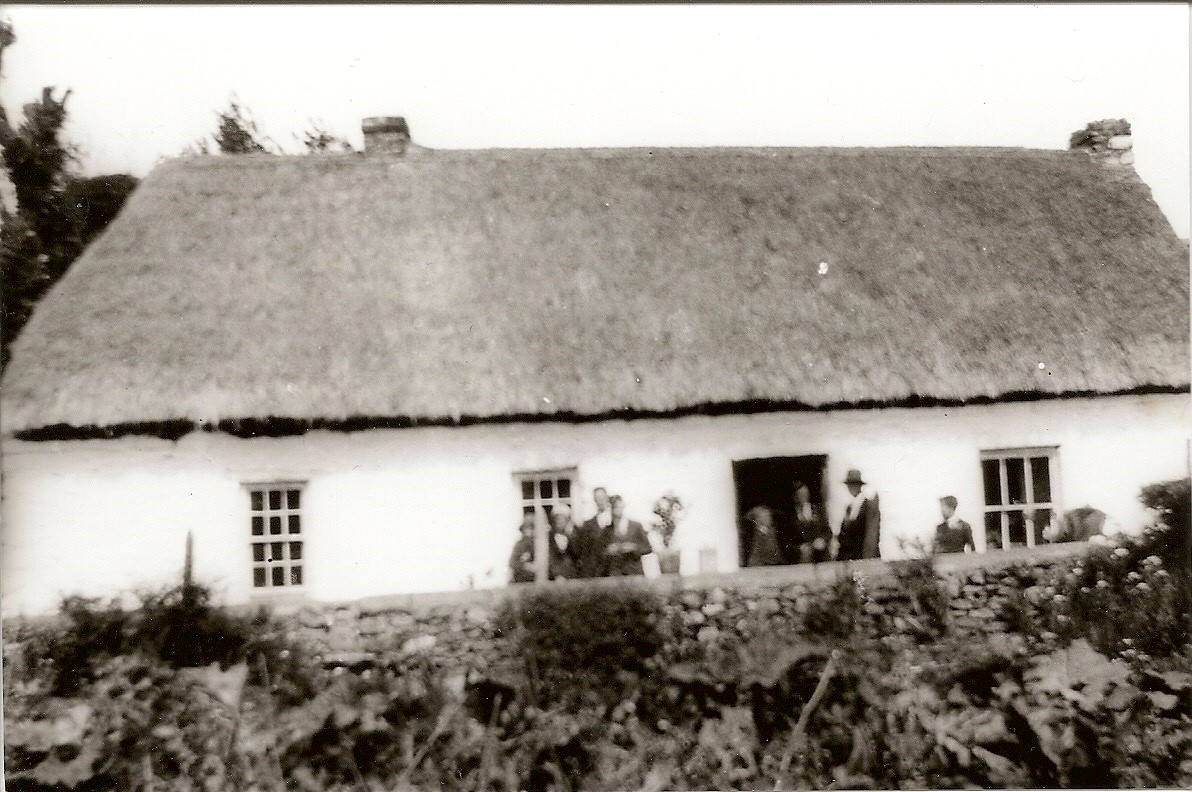
A Thatched House in Lower Abbey circa 1940s. Photo courtesy of Tom Keane
Danny, our thatcher from Easterfield, was the man who shaped, trimmed and stapled the straw bundles onto our roof. Just like the thatcher in Seamus Heaney’s poem, Danny had the Midas touch. Wheaten and oaten straw provided the best run-off options; there could not be any leaks as the very purpose of roofing, from Day 1, was to keep the house dry and possibly warm. If living near the Shannon River, one could and would have used reeds. We, in Abbey, controlled our straw supply from its sowing to its harvesting and threshing. For thatching, we also needed hazel or willow. We knew that hazel gave us our Halloween hazelnuts and now we were happy to cut, sharpen and twist our hazel rods into u-shaped scallops to secure our thatching straw. I would have to complete some years with Danny, before I could progress to touching his mallet or shears. Thatching was usually handed down from father to son, similar to many other trades of the time. Second and third level education have modified some of the more demanding procedures of “training on the job”. Before that time, the Leaving Cert was literally so, either leaving for London from Dun Laoghaire via Holyhead or to New York from Cobh. Four young girls emigrated to the U.S from our thatched home and two young men left for World War II, one of whom did not return. I’m sure that many other thatched houses could relate similar stories.
A thatched roof was always a fire hazard as one could easily start from a spark from the chimney; I remember a small fire being extinguished by express application of water from a nearby well, using a long ladder and galvanized steel bucket. Getting house insurance for a thatched property is a current problem, back then it seemed house insurance was not even considered.
Some birds liked to disturb a honeycomb thatch finish and of course, mice were always on standby on the ceiling; they, sometimes, expressed themselves at their loudest, during the recitation of the nightly Rosary.
No Comments
Add a comment about this page